Search This Blog

Thursday, August 11, 2011

Glimpses of Three Friends Studio

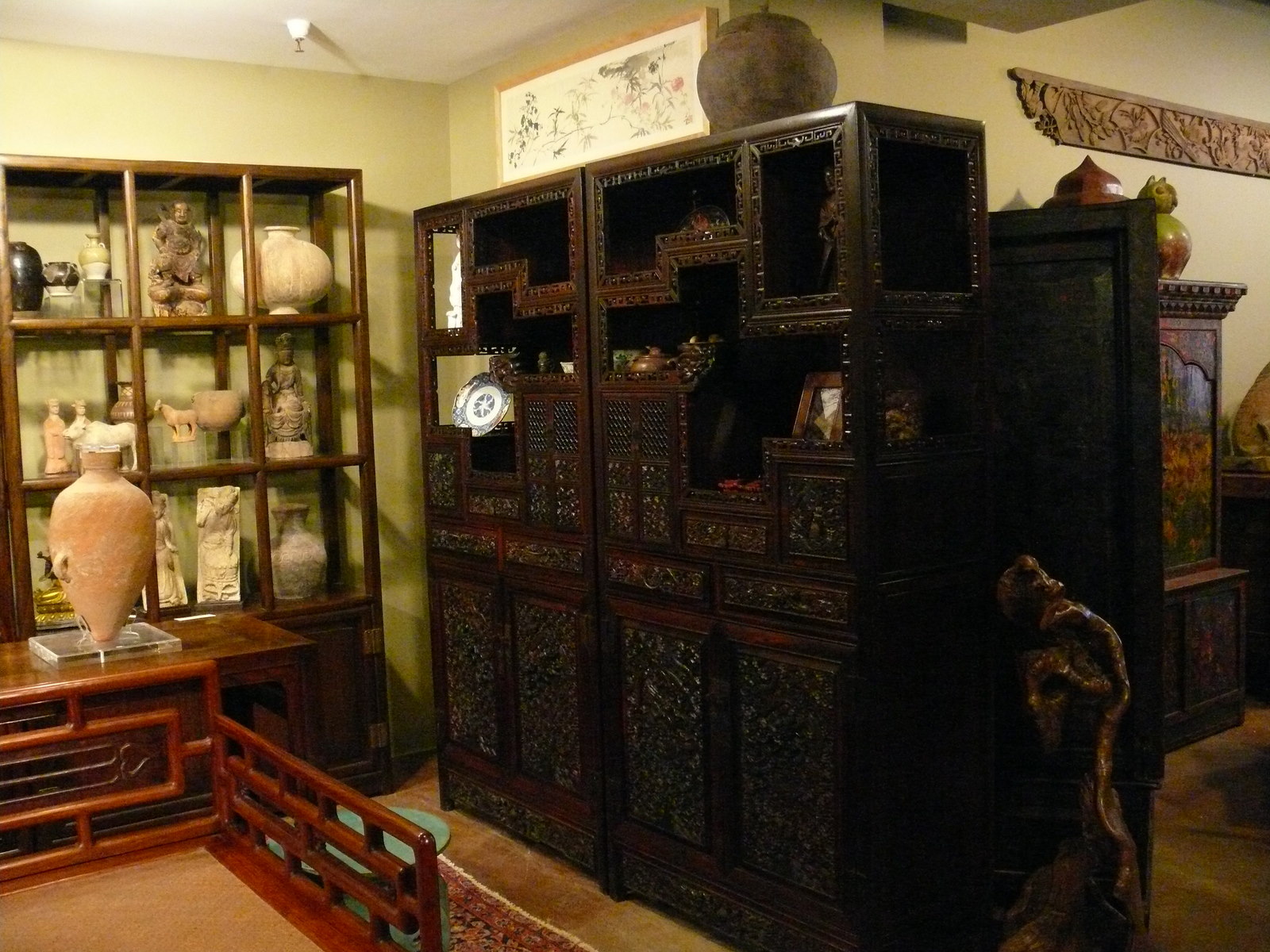
I would like to thank all the viewers of this blog and as a token of my appreciate, I would like to share images of the environment where I do some of my writing.


Three Friends Studio is a treasure trove of antique Chinese furniture, architectural artifacts, antiques, antiquities and accessories.  It is located at the Merchandise Mart in downtown Chicago.  The collection is displayed over 4000 square feet, with ample space between objects for easier viewing.  Recognize some of the furniture from previous blogs?

For more furniture and antiques, please visit http:\\www.threefriendsstudio.net

Saturday, July 30, 2011

A STORY ABOUT CHAIRS

My Grandma never walked. I do not mean she was lame. As long as I could remember, she was always sitting in her chair, a beautiful Victorian period chair with expensive upholstery. When she had to go somewhere, she would travel by car or be carried by two strong coolies in a sedan chair. During my childhood in Hong Kong, my inquisitive nature often steered me to eavesdrop on adults’ private conversations, especially Grandma’s. I am a member of a large family spanning several generations. In those days we lived in a very close-knit community where virtually no one could do anything without scrutiny. Most of the bits of conversations, now forgotten, were idle gossips that involved relatives in the latest drama, which among this large assembly of family members, was a natural occurrence then as it is now. However, some poignant stories remain, especially those oblique remarks that I thought I understood but the meanings were beyond my youthful comprehension. These I have filed in the unused compartments of my brain, and there they stayed for decades, waiting for me to fully grasp the significance.

How then, does this relate to interior design? If you have the time, you will grant me the indulgence of telling you a story. A long time ago, Grandma, whose father built Komtong Hall (please refer to the blog dated January 2011) visited her favorite nephew and his bride living in "exile," away from their Hong Kong family from which they were estranged. The young people found themselves in this predicament because they had married against his parents’ wishes and he and his bride were unable to live in his former lifestyle. Grandma was appalled that her nephew was living in such austere conditions and he could not even offer her a chair because all he had for seating were stools. If you read on, you will find out why.

In Chinese culture, where you sit signifies who you are. Emperors and Empresses sat on thrones and carried on palanquins. Abbots and high officials sat on armchairs with yoke backs and resting their feet on foot stools. Chairs were designed for ladies with low backs and folding chairs were reserved for special guests. Here are some illustrations:
Folding chairs were very special chairs. In a wealthy home, the chair was reserved for an important visitor. Generals watched on going battles sitting on their folding chairs. This chair is embellished with good metalwork.
The chair is named Southern Official Chair because it was the intended seat for an official. Sumptuary Laws in China dictated that non officials could not own such a chair - a law that might be difficult to carry out.
Rose chairs are intended for the lady's chambers. This six sided chair is made in imitation of bamboo chairs. I often wonder why the Chinese would go through the trouble of making wood chairs using the same joinery? Is it because chairs made of wood are more permanent than bamboo chairs?

Moon gazing chairs are very popular recliners.


In reference to the story about my Grandmother and her innuendo about the stools, I have always taken it on face value until it dawned on me that Grandmother’s comment about the absence of chairs in her nephew’s home carried a double meaning. In truth, was she commenting her nephew’s lost of face and social standing? Not owning chairs reduced one’s status to just higher than the working poor who found squatting a comfortable way of relaxation. On the other hand, was Grandmother lamenting that she also lost face by sitting on a common stool? I will never know. This story has a good ending. The young couple raised a large family. Their sons inherited a huge fortune and they are known for their philanthropy.

Thursday, June 2, 2011

A Stunning Metamorphosis


In the antiques trade, dealers fall into this profession not entirely by choice, but mostly by circumstances.  However, they stay because they like to shop and buy.  I am no exception, though I prefer to think I am a rescuer of objects.  When Michael and I go furniture hunting in the antique furniture market in China, I frequently would see a quality piece standing alone among its inferiors.  Sometimes a Chinese idiom loses its punch in translation, but this one that relates to plucking a flower growing among cow dung is pretty straightforward.  During one of our trips, I found this well constructed elm cabinet.  It caught my eye standing in the back of a dark and dusty shop.  Dirt and dust covered the beautiful graining of the fine furniture wood.  It was appealing because of its clean lines and square corners and a plain apron without ornamentation.  This simplicity of form is a classic style of the Ming Dynasty (CE1368-1644.)  The top portion of the cabinet is accessible through the pair of doors, and the only access the to the lower portion is through a hidden inside panel.  This was the acceptable usage of the cabinet and it served a dual purpose – seasonal changes of clothing were rotated between the top and bottom which also stored the family’s valuable possessions.  However, the last owner had reconfigured the cabinet by adding drawers and opening the closed bottom section with a pair of doors.  The alteration allowed easy access but it also affected the antique quality. So it was banished to the back and judging from the layers of dirt, for a good long while until we recognized its useful qualities. Its simplicity of form blends well with contemporary furnishing. 
As the focal point of a room, a single piece of Chinese furniture does well. However, size, shape and finish do matter, so the elm cabinet stood waiting in our warehouse until Sarah van Assche of Sarah van Assche Interiors found it useful in one of her projects.  She needed a large, well made piece of furniture with good storage for a sophisticated lady with young children.  Sarah has vast experiences incorporating antique Chinese furniture in her designs and she saw beyond the cabinet and visualized its transformation into something of beauty that would be compatible in a contemporary setting.  A new blue grey slightly distressed finish, new hinges and hardware completed its metamorphosis.  When I saw a photograph of the cabinet in its new abode, I was totally stunned!

www.svainteriors.com

From Sarah Van Assche Interiors - Tranquil Harbor Country Master Suite


Thursday, May 19, 2011

Ivory Conundrum

I would like to begin by thanking every viewer for visiting my blog and to apologize for the long absence.  There are many interesting ideas, but the one that I need to express is a recent conundrum I had with ivory.  Ivory carving was an art form perfected by the Chinese and later by Japanese artists/craftsmen in the 18 and 19 century respectively.  In the early days, elephant tusks were found in piles, and elephants were not killed for their tusks.  No one carves new ivory today, but lately there is a resurgence in the art market for old ivory objects d’art, such as this 10 inch tall vase from the eighteen century Qing Dynasty illustrated here.  It was sold at the March 2011 Asian Arts Auction at Freeman's in Philadelphia.

Recently I was an exhibitor at the International Antiques Fair at the Merchandise Mart in Chicago.  An acquaintance from Mainland China named Lan whom I met a few months before asked if I could help her out.  She needed some advice on buying ivory.  I do not sell ivory but I do have some knowledge by being on the antique show circuit and ivory was an important craft in Hong Kong where I grew up.

Lan led me to a fabulous display of antique ivory objects in a space belonging to an important dealer of high end art objects.  There were both Chinese and Japanese ivory carvings and they ranged from artistic pieces to ones that were exquisitely carved but made for the export market.  She asked very basic questions – were these real ivories, were they old and why were they in different colors?  Immediately I knew Lan had no notions about ivory but she was on a dangerous mission to buy some for her brother who lives in China.  I stress on the word dangerous – it is so easy to make mistakes when one buys antiques.  The rule in the antiques business is you either trust the dealer or yourself.  In Lan’s case, she did not know the dealer and she was treading into territories without prior knowledge.  She was counting on me, and putting me on the spot where my advice could either cost the dealer a good sale, or Lan a bad investment.

I realized Lan did not have my advantages.  I, the ever inquisitive child who dawdled in front of ivory shop windows in Central (downtown Hong Kong) at least once a week and memorized every design I had seen from figurines to ivory balls with movable centers.  Conversely, I was also privileged to learn early on that ivory in private collections bore no resemblance to the commercially produced carvings for the tourist trade.  Art objects made of ivory were unique designs of beauty in form and execution.  It could be a large elephant tusk where every centimeter was covered with exquisite carving to something as small as a seed on which poetic inscriptions were not visible to the naked eye.  So how could I transmit this accumulated knowledge of a lifetime in a few sentences with a language problem to boot?  My ability to speak Putonghua was even more challenged than Lan’s English comprehension.  Somehow I managed to convey to her that as a fellow dealer in the show, I should not influence her buying, the decision had to be hers.  Secondly, I could tell her about the pieces that she was interested in, why some pieces cost more than others and which were the ones worthy of collecting.  Thirdly, I could advise her to tell her brother as a new collector, he should get the most for his money, and in this case, it would be exquisite carving on a piece with good size.  Then I walked away, leaving Lan to do her own negotiations.

Later on I was relieved to find out that Lan did make a purchase.  She was as eager to buy as the dealer was anxious to sell.  She selected a good pair of 19 century ivory vases that were made for the export market.  In the following day, ivory objects sold for astronomical prices at Leslie Hindman's Asian Arts auction.  Lan did very well indeed.

Postscript 
The idea behind this piece is not to promote nor condone the sale of artistic ivory objects.  I just wish to make a point that sometimes art dealers are put "on the spot" and that was the exact case.  I like to think I am a "good" dealer and I have my own ethics.  I do not wish to misguide a novice collector nor do I wish a fellow dealer to lose a sale.  Fortunately it all turned out well for all concerned.

Tuesday, February 22, 2011

Finding old Shanxi Furniture

Sometimes the feelings of exhilaration resulting from a great purchase are not consciously felt until years later.  The realization came when I reflected on a 17 century cabinet decorated with lively dragon designs.  It is one of many pieces that we bought on that particular day many years ago.  My husband Michael and I were shopping at an antique furniture market in Zhongshan, near Guangzhou (Canton) with our agent Leong who brought us to a shop ran by two brothers from Shanxi ProvinceShanxi is located in North Central China, a province that is part of the cradle of Chinese civilization.  By the Ming Dynasty (CE 1368 to 1644) it was the land of stately homes belonging to rich merchants and bankers who furnished their living interiors with the best furniture Chinese craftsmen could offer.  Shanxi furniture is desirable because varieties of high quality wood for furniture were available – northern elm, walnut, locust, oak, laurel and cedar.  We looked around and did not see anything worth buying.  The shopkeeper noticed our disappointment and told Leong that his brother had gone shopping back home and was due back later in the day with some great finds and would we come back after lunch.

Lunch in South China is as important as dinner.  Cantonese live to eat, and as the saying goes, they will eat anything that has four legs except a table.  Leong would order more food than we could possibly eat and anything less would be considered losing face. And I, saving face, would try to swallow morsels of the exotic delicacies he offered.  Fortunately for me, luncheon that day was a simple fare.  The anticipation of  new merchandise made all of us too excited to eat. Michael too, was busy giving me admonitions that I should keep a poker face; any excitement would cost him extra. 

We found a small crowd waiting outside when we returned to the shop.  The men were chain smoking while waiting.  Then we saw a cloud of dust following a small convoy of open back trucks (called Lorries) laden with furniture tied down to the frames.  The drivers stopped, jumped out of the cabs and started unloading.  It was hardly what I expected; cabinets were taken apart and tied in bundles, chairs and small tables the same way.  This is possible because all Chinese furniture is held together with joinery without using nails, and each piece can be taken apart and easily put back together.  One must have the expertise to visualize what the end result would be.

Babel erupted among the crowd.  Furniture dealers communicated in their local dialects.  Cantonese, Putonghua, Fukinese, and dialects that were new to me.  Leong brought our attention to a few choice pieces. Michael nodded his approval and he marked them with our name. Then a bidding war started.   The Yuan was weak and the US dollar strong.  Needless to brag who came out with the best pieces; the local dealers were not pleased.

Alas, the thrills of shopping for antique furniture are all but over.  Since 2009, China has imposed a ban on exportation of anything older than 1920’s, and that pretty much means everything good.  The strong Chinese economy signals the tables have turned.  We cannot go back and buy as we did.  Savoring the euphoria we felt that day, we realize that opportunity would never come again.  Nevertheless, we did well. After heavy cleaning and light restoration, those bundled pieces of wood became these fabulous pieces. Shanxi furniture exemplifies the finest features of Chinese vernacular furniture – fine quality wood and craftsmanship. With a little imagination, each of these pieces can be the focal point of a room. Shanxi furniture is well known among collectors but has not been properly introduced to the general audience.  It is a worthy topic for further discussion.

17 Century Walnut Cabinet with Dragon Designs


17 Century Lacquered Cabinet


18 Century Altar Table

18 Century Painted Cabinet

Friday, January 28, 2011

Sentimentality versus Practicality

When a piece of furniture captures my attention, the motivation to buy is not always pecuniary.  Sometimes I confess I was driven by sentimentality. The purchase soothes my heart and soul, but in my inventory it indefinitely dwells. One such piece is the handsome black lacquer curio cabinet pictured here.  Made of cedar or a similar wood, the surfaces were coated with black lacquer.  Unusual breaks from the traditional symmetry, shelves in the top section are staggered in different levels for interesting display of curios and antiques.  The multiple drawers are perfect for holding small objects like jades and seals.  More antiques can be stored in the lower section for occasional rotation.  The black background and the uneven spacing provide an ambiance for the pieces of antiques and enhance their value. So why did I buy it?  In another time and place, a curio cabinet like this was forever etched in my memory, displaying objects of art that were not to be forgotten.

The last time I saw it was a sneaked peek into my great-grandfather’s Curio Room in his stately home in Hong Kong.  Great-grandfather Ho Kom-tong made his fortune in successful business dealings. But he was best remembered as a man with a wife, eleven concubines and twenty seven children - a local record that has yet to be surpassed.  A reputation like this obviously overshadows his fame as a collector of antiques and curios. His house Kom Tong Hall, built in 1914 in a classic revival style, boasted of a walk-in safe, a place to keep his extra antiques as he rotated his collection. His European antiques were on display in the drawing room named the French Parlour, so named because of the white and gold architectural features that included ionic columns and gilded ceilings with crown mouldings and furnished with French provincial furniture.  His Chinese antiques were exhibited in glass vitrines in his living room upstairs, filled with Guangdong black wood furniture that were ornamented with designs made from mother-of-pearl.  The rare and valuable pieces of the collection were kept in the Curio Room where Great-grandfather would entertain his fellow collectors and visiting dignitaries by showing his latest acquisitions of archaic jades or painted porcelains.  Children were forbidden to enter the room. On one occasion when I, a small child of no more than six, found the door ajar and stole a glance, before my nanny shooed me away, her main charge was to make sure I would not misbehave.  The moment was short in sight but long in remembrance - an unforgettable memory of beautiful objects on display in his curio cabinet.  As time progressed and my interest in Chinese art grew, these objects acquired names – the square tube became an archaic jade cong, the lady in white was a blanc de chine Guanyin, and the pretty vases were Qing Dynasty painted porcelains.

The art collection survived World War II and was noted as being one of the best private collections in Southeast Asia.  A museum in Australia offered to buy 400 of the best pieces but Great-grandfather was ill advised to send the collection to New York for auctions.  And that was that.  No one knew what happened to the objects or the monies from the purported sales.  Upon his passing, family members retained some pieces and the remainder sold.  Even until twenty years ago, unscrupulous dealers on antique row in  Hollywood Road and Cats Street would surreptitiously embellish the salability of an antique by giving it a false Ho Kom-tong provenance.

Kom Tong Hall was preserved as a historic building by the Hong Kong Government.  After extensive renovations, it opened in December 2006 as the Dr. SunYat-sen Museum, to commemorate the founder of the Chinese Republic.  I make it a ritual to visit whenever I am in Hong Kong. The Curio Room is no longer forbidden, it is now part of the exhibition space.

For views of Komtong Hall please watch this video by frl:

Saturday, January 1, 2011

Beautiful and Mysterious

 LARGE PAINTED LACQUER COFFER
18th Century
76” x 22” x 37”H

One of the great joys in the Chinese antique furniture business is finding a piece that is a real puzzler. Michael, my husband and business partner, purchased it in a furniture market in Southern China a number of years ago.  This particular coffer has an unusual trapezoid shape that is unfamiliar in Chinese furniture.  Its black lacquered surface is decorated with groups of bird and flower painting with beautiful rendering of brush work in pastel tones that seem to have a luminous quality.  Still life studies of flowers and fruits are grouped with antique objects and they all share the auspicious symbol of wealth and prosperity.  The style of the painting is neither Chinese nor Japanese.  The still life grouping of objects is more often seen on painted Korean screens.  The whole presentation of the coffer shows a painted art object that is formal, well organized, and beautifully rendered, but they do not share the mannerisms that are associated with Chinese, Japanese nor Koreans.  What then, are the elements that so persuasive? Take the birds on the flowering branches for instance.  This is a subject matter found in all three cultures.  Why do I look at them and think European Botanical Print?  My formal training in the history of Chinese and Japanese painting led me to the deduction that the entire schematic structure, despite its beauty, does not adhere to the Chinese painting tradition.  On the other hand, it harks of elegance and refinement that are associated with Japanese painting, but the composition is too complex.  When in doubt, I try the third alternative – Korean, but none of the elements applied here.

So the coffer with the trapezoid shape continued to delude us until we happened upon a similar piece in my cousin’s apartment in New York City.  Her coffer was in the same style and shape as ours.  According to the information which was based on the research of a well esteemed Chinese art historian, these painted coffers were specially made in the Ryuku Islands for a rich Chinese merchant who imported them to the Peking (Beijing) market in the 18 century.  We know about the Ryuku Islands by way of Okinawa.  It is an island chain that extends from the southern Japanese island of Kyushu to the northern tip of Taiwan Island.  In ancient times, it was an independent kingdom.  The Chinese and Japanese fought over its sovereignty from the 14 to the 19 century.  Under Japanese sovereignty, many Koreans came to work on the islands.  They brought with them their artistic tradition and technique that were neither Chinese nor Japanese but had a unique quality all their own. By the 18 century, European bird and flower painting would have arrived in Japan in the form of botanical prints.  Could it be plausible that the Ryuku artists learned the western technique and applied them here? That would offer an explanation why the unusual rendering of the birds and flowers deviate so far from Asian traditions, yet the cumulative effect is a reflection of the art of all three cultures.

The knowledge places the coffer in a different perspective.  We have learned that this was a special import, therefore highly treasured; that it was rare, for few were made.  Long ago it graced the environment of a wealthy home, and now in a formal room, it can resume its importance as a focal point once more.